
Animals in Nyerere National Park
Animals in Nyerere National Park, Remote and untouched, Nyerere National Park represents one of the lesser-known places. If you want to be surrounded by wildlife and natural beauty, this pristine park will cure your thirst. More importantly, you will enjoy all these without having to compete for wildlife sightings. While famous destinations like the Serengeti and Ngorongoro Crater host world-famous wonders, including the Big Five and the Great Migration, Nyerere has its unique touch.
Nyerere National Park is, of course, a new name in the world of travel. Previously, it was known as Selous Game Reserve and had a strong reputation. Named after Frederick Selous, a British professional hunter and conservationist, this game reserve was the largest in Africa, spanning 50,000 square kilometers (19,300 square miles). In 2019, about 30,000 square kilometers (11,580 square miles) of the reserve was designated as a national park, named after Julius Nyerere, the first president of Tanzania.
Therefore, for clarity, Selous Game Reserve is still there, and it covers about 20,000 square kilometers (7,700 square miles). The reserve offers hunting safaris in addition to traditional game drives, but the main park is perfect for wildlife viewing and other safari activities. Enough with the basics; let’s get back to our question. What animals can you see in Nyerere National Park?
What animals are in Nyerere National Park?
African wild dog
One of the unique highlights of Nyerere National Park is the highest concentration of African wild dogs. Also called painted wolves, these small, mottled dogs are among the rarest sightings in most northern parks. After a population decline in the 1990s due to canine distemper, wild dogs disappeared in the Serengeti and neighboring destinations. Today, Nyerere is home to about 1,000 wild dogs, which is the largest population in Africa.
Wild dogs are restless predators: one hour is enough for them to move 5 kilometers. Our pro tip is to visit water sources, like the Rufiji River, and lakes found in Nyerere, to stand a chance of seeing them. What luck to witness pack hunting! Their collaborative hunting technique makes them the most successful predators, with an 80% hunting success.
Elephant
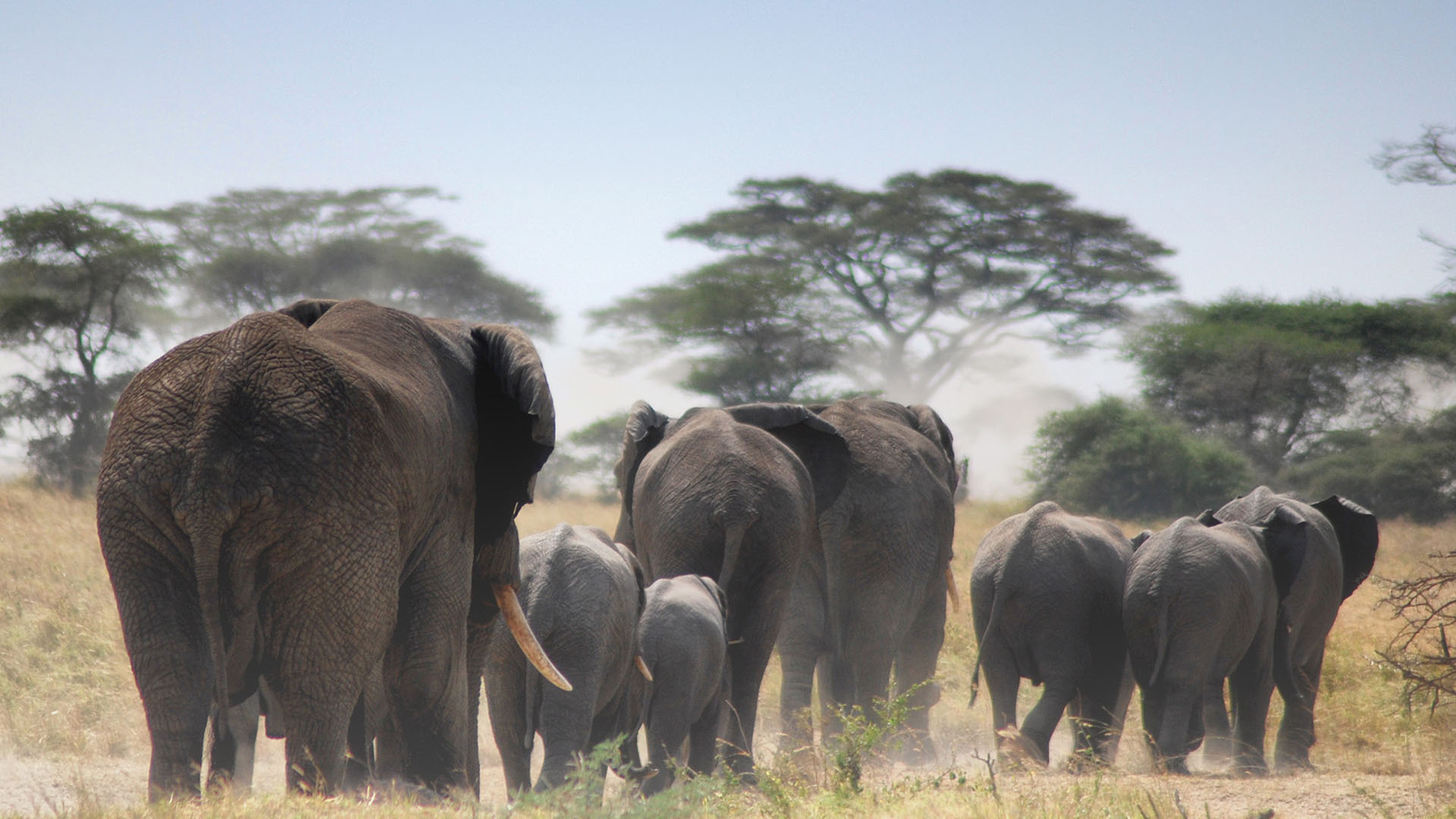
The giant mammal with a grey coat roams the pristine forests of Nyerere majestically. Thanks to their existence in Nyerere, they shape the ecosystem: they break branches to pave a way for other animals to move around and eat fresh grass. Elephants form family bonds of up to 20 tuskers, controlled by a single matriarch leader responsible for searching for food and water. You can see herds moving along the riverine forests of Rufiji and seasonal swamps.
African lion
Nyerere is also home to the African lion. Known for their orange-brown coat and slender, blue or black mane for males, lions are the favorite animals for many safari-goers. In Nyerere, they form large prides and rule the vast plains and woodlands.
Black rhino
Nyerere hosts a few black rhinos. But to be honest, they require special attention and a bit of luck to encounter. The thick vegetation of Nyerere makes it even harder to find them as they hide in thick shrubs and thickets. Our guides, however, have bumped these massive creatures several times. So, we are confident you will encounter them.
Giraffe
Tall and elegant, this graceful browser is also resident in Nyerere National Park. It’s often spotted browsing in the topmost leaves of kigelia and acacia trees. You can always see them during daily game drives in Nyerere National Park. Drive along the Rufiji River in the afternoon to find them drinking from the river.
Wildebeest, zebras, and gazelles
You have a 100% chance of seeing wildebeest herds and their zebra companions. While the wildebeest in the Serengeti migrate, in Nyerere, they stay within the park and around surrounding protected areas. Gazelles, being a favorite meal for the big cats, support an incredible population of predators. However, the ecosystem of Nyerere is denser than that of the Serengeti. Therefore, herbivores can escape predators by just running through thickets.
Hyenas
Hyenas never stay away from lions for one reason: to seize the leftovers. These nomadic scavengers can devour anything, from decaying bones to weak or sick herbivores. You can hear their haunting calls as the sun dips into the pristine wilderness. Hyenas are not good at hunting because they lack speed, skills, and timing. However, they usually take advantage of weak animals. In most cases, the animal will die in agony since hyenas don’t kill first—they eat first until the animal dies.
Cheetahs and leopards
Cheetahs are often spotted resting on rock outcrops. They use these spots as vantage points to scan for animals from a distance. Leopards, on the other hand, are always seen resting in sausage trees. In early mornings, they are often surveying the plains to catch prey for breakfast.’
Both leopards and cheetahs are excellent at hunting. They would stalk their prey for almost an hour before engaging in a high-speed chase. Once successful, they drag their kill up a tree to avoid noisy scavengers like hyenas, which may attract lions and cause more trouble.
Hippos and crocodiles
In the riverine pools, you will find giant, black hippos and Nile crocodiles. Large pods of hippos are often seen along the Rufiji River. Crocs get out of the water to bask in the sun. All these animals make frequent appearances during boat safaris.
Birds
Nyerere is also a birders’ paradise. At least 400 bird species call this park home. River birds like African skimmers, ducks, swans, and pink-backed pelicans are commonly seen during boat cruises on the Rufiji River. Other birds include the yellow-billed stork, African spoonbill, lilac-breasted roller, Marabou storks, saddle-billed storks, and Udzungwa forest partridge.
The bottom line
There’s much to explore in Nyerere. On top of animal species, visitors can watch a myriad of bird species that call this park home. Plus, there are a lot of safari activities to do, including boat safaris, guided nature walks, night drives, and fly camping. We are here to help you discover the untamed beauty of Nyerere National Park.