
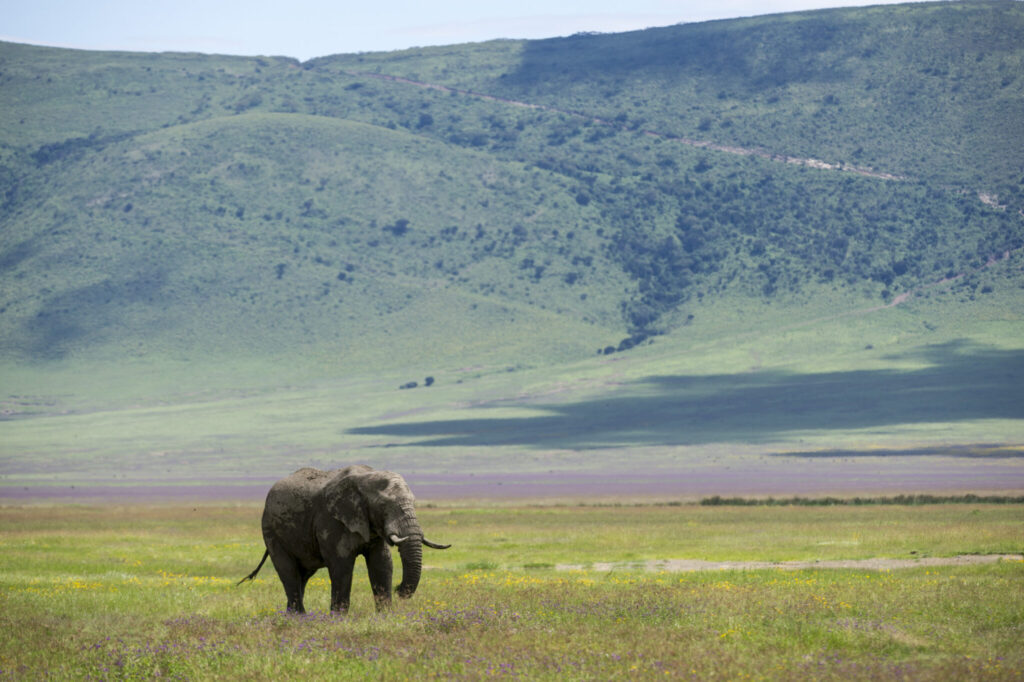
Facts about the Ngorongoro Crater
Facts about the Ngorongoro Crater, About 2.5 million years ago, the tallest volcanic cone of the Ngorongoro Mountains collapsed internally to form the Ngorongoro Crater we see today. Luckily, this majestic caldera hosts one of the world’s highest wildlife densities. And still the highlands make the crater walls beautiful with their misty, azure blue appearance. This enormous crater is a wonder to behold. On this blog, we’ve gathered six interesting facts about the Ngorongoro Crater.
1. It’s the world’s largest unbroken volcanic caldera.
The Ngorongoro Crater is unquestionably the world’s biggest intact (unbroken) caldera. Wait! What’s a caldera? A caldera is simply a bowl-shaped structure formed when a volcanic cone collapses from inside, usually after losing support from magma. The crater we see today is a hole left by the top of the cone after internal collapse.
Enough with lecturing; let’s get back to our topic. Ngorongoro Crater spans 260 sq km (100 sq miles) and has a diameter of 18 km (11 miles). The height of its crater walls rises to about 600 meters (2000 ft) at its highest points. That’s the same height as the Makkah Royal Clock Tower, the world’s fourth-tallest building.
Many craters of this size exist, but they are broken and watery. However, Ngorongoro is still unbroken and hasn’t filled up with water except for the soda lake, Magadi, located on the crater floor. The result is open grasslands, forest patches, swamps, and hills.
2. There are no giraffes in the Ngorongoro Crater.
A surprising fact about Ngorongoro Crater is the absence of giraffes. The lack of tall, open woodlands preferred by these tall mammals makes the crater not worth their presence. The crater walls are also extremely steep, which makes it even harder (or simply impossible) for a giraffe to walk in and out.
But we know how guests are attracted by the beauty of these gentle animals. We’ll make sure you see them as we drive in the Ngorongoro Conservation Area, the Serengeti, or Tarangire, where they live. In the meantime, enjoy watching other animals.
3. Over 25,000 animals live in the Ngorongoro Crater.
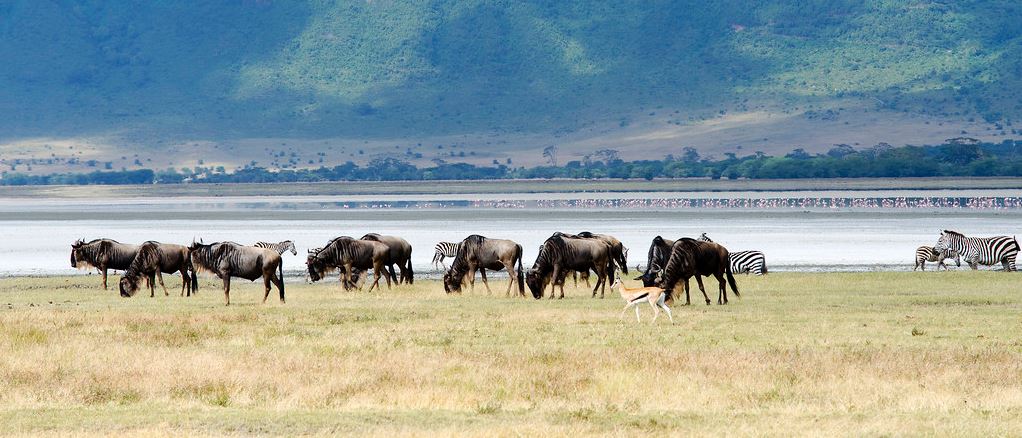
An interesting fact about this enormous caldera is its dense wildlife concentration. Imagine such a huge number of large animals living in a 260-sq-km enclosed bowl-shaped caldera. That means you will spot 90 animals in every square kilometer.
Unlike wildlife in other parks where migration is common, animals stay inside the crater year round. The crater has fertile soils covered by nutrient-rich grass that feeds a large population of herbivores. The water sources in the crater floor, including Lake Magadi and Gorigor and Mandusi Swamps, provide water for the wildlife.
Additionally, the crater boasts a significant number of predators, namely lions, leopards, hyenas, and bat-eared foxes, that help to balance the population of grass-eaters. The result is a sustained ecosystem.
4. It’s easier to spot the Big Five in the Ngorongoro Crater.
The search for the Big Five in Africa is always not a straightforward safari. A few protected areas host the Big Five, the lion, leopard, rhino, buffalo, and elephant, in one place. Ngorongoro Crater is one of them.
The Big Five are actually not that big except for the African elephant, black rhino, and Cape buffalo. Named so for their bravery and scary nature when they charge, all these five animals call this enormous caldera and we know where to find them.
Buffalo and lions, for instance, love expansive grasslands that account for almost three quarters of the crater’s ecosystem. Leopards live in the forested rims of the crater and in the Lerai Forest. To spot leopards, keep an eye out for acacia or sausage trees, where they hide.
Elephants frequent Gorigor and Mandusi swamps to quench thirst and cool their bodies. The crater hosts a small number of endangered black rhinos under constant surveillance to protect them from poachers. But the nature of the crater’s ecosystem allows you to spot easily.
The icing on the cake is that 18 white rhinos have been reintroduced to Ngorongoro Crater in March 2025. The crater’s open grasslands favor the flourishing of these grazers who were once lost in the crater.
5. The highest density of lions is found in the Ngorongoro Crater.
Approximately 70 lions live in the Ngorongoro Crater—that’s the world’s highest concentration of lions. Wait! The Serengeti hosts about 3,000 lions… We know what you think. In terms of population, the Serengeti is home to one of the largest lion populations not only in Africa but also in the world.
But the crater is only 264 sq km (100 sq miles). The density of lions is one lion per every 3.7 square kilometers compared to the Serengeti’s lion density of one lion in every 4.9 sq km.
What interests us about lions in the crater is that they don’t care about safari vehicles nearing them. They are the most studied lions so far. Hence, they are less afraid of vehicles and guests. Don’t be surprised when a majestic maned lion finds shade under your safari vehicle.
6. Only the Maasai are allowed to walk in the Ngorongoro Crater.
Since the crater gets huge traffic, authorities prohibited some safari activities. Walking is one of these activities. Even driving is only allowed for just six hours to monitor traffic.
But the Maasai are allowed to walk on the floor. The Ngorongoro Conservation Area Authority regards them as part of the ecosystem. So, they allow them to herd cattle inside it when other parts of the conservation area dry out.
There’s still a chance to walk on the crater rim. Most lodges located on the rim offer walking safaris on the rim. You may encounter leopards, buffalo, monkeys, and other animals. The panoramic views of the floor are also captured from view points on the crater rim.
Let’s design your safari
Now that you know a little bit about this enormous caldera, why not book a safari? Our guides will tailor your safari to your needs, budget, and timeline. We are also open for further inquiries should you have any. To begin planning, email us at info@exploreafricansafaris.com.