
Your Ultimate Guide to Nyerere National Park in 2026
Your Ultimate Guide to Nyerere National Park in 2026, If you are looking to experience Tanzania’s wildlife in 2026 without the crowds, then Nyerere National Park (previously Selous Game Reserve) is the right place to go. Located in the south-eastern region of Tanzania, Nyerere is a newly established park from the Selous Game Reserve, then Africa’s largest game reserve. This park boasts a variety of attractions, including wildlife, landscape, and water bodies.
However, Nyerere still gets just a fraction of the visitors coming to Tanzania. And we expect no significant rise in tourist numbers in 2026, making it a go-to safari destination for secluded safaris. In this guide, we’ll unveil everything you need to know about Nyerere National Park. Let’s dive in.
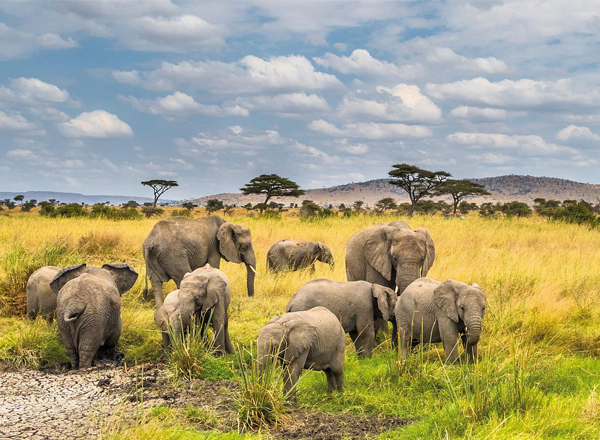
How Big is Nyerere National Park?
To go straight to the point, Nyerere National Park spans about 30,000 square kilometers (11,580 square miles) and is Tanzania’s largest national park. And when compared to other parks in Africa, Nyerere emerges as the largest standalone national park.
Getting to Nyerere National Park
There are two ways to get to Nyerere National Park: by road and by air. But we highly recommend the latter—flying. Here, you fly from Tanzania’s busiest capital, Dar es Salaam, to one of the airstrips in Nyerere. The flight is about 45 minutes long. Airstrips include Beho Beho, Siwandu, Matembwe, Kiba, and Mtemere. Your final destination depends on the location of your lodge.
What to see in Nyerere National Park
Big Five
Nyerere is among a few places in Tanzania where you can see all the Big Five animals. This group, which is named so for its brave nature, comprises the lion, elephant, buffalo, leopard, and rhino. However, it should be noted that rhinos are rarer than the rest, making it challenging to spot them. The rest are easier to see during game drives.
Wild dogs
Wild dogs deserve a special treat because they are not frequently seen in most parks in the north. Nyerere, which holds the largest population of these painted wolves, has sightings guaranteed. These painted canids are known to cover about 50 km in length while searching for prey.
Rufiji River
Rufiji, the largest river in Tanzania, runs through Nyerere National Park. It’s big and flows throughout the year into the Indian Ocean on Mafia Island. This river is navigable, allowing for boat safaris. It’s home to giant hippos, crocodiles, and a myriad of river birds.
Other animals.
There are plenty of animals to see in Nyerere. On one drive, you encounter herds of wildebeest; on the other, a pack of hyenas. Giraffes, cheetahs, bushbucks, impalas, reedbucks, hartebeest, and more. Nyerere hosts even the rarest species, such as the Lichtenstein hartebeest, blue wildebeest, sable, and roan antelope.
What to do in Nyerere National Park?
Wildlife viewing in most northern parks revolves around traditional game drives. But in Nyerere, it’s more than that. Here are some bucket-list activities to do in this pristine destination.
Boat safaris
The Rufiji River and the lakes are excellent places for boat cruising. This adventure is comfortable and more relaxing. It’s often done during the evening to view wildlife and landscapes from another perspective. During the glide, you will see animals, such as hippos, crocodiles, and many others. This boat ride lasts for one hour, and it will cost you around $25 to $30 per person for a group of 5 to 6 people.
Night game drive.
Some animals are hard to catch during the day. If this is the case, then a night drive is the best solution for you. After the sun dips down, the world of nocturnal species comes alive. On this drive, you may see porcupines, jackals, bat-eared foxes, wild cats, and large predators like lions and leopards. The adventure usually starts after dinner and lasts for two hours. The shining stars, calm night setting, the sounds of nature… and more are all yours. This sunset drive costs around $300 per person.
Fly camping
Evolved from old-school style, this activity is a must-do in Nyerere National Park. The experience is offered by some lodges and camps in Nyerere, so it is essential to check if your accommodation is offering it or not. In a simple, mosquito-netted tent, you will relax while listening to the sounds of nature, like a lion’s roar or a breaking branch. Our favorite camps offering fly camps include Sand Rivers, Beho Beho, Kiba Point, and Kokoko Camp.
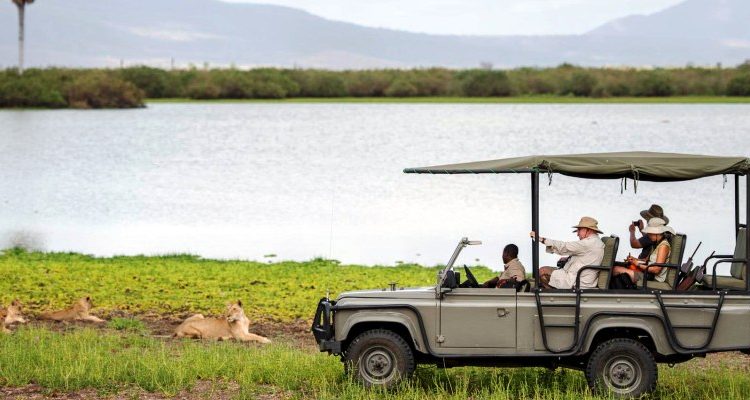
Secluded game drives
While safari vans scramble for a lion sighting in the Serengeti, Nyerere offers a golden opportunity to view animals without the hassle. Drives are secluded, allowing you to fully immerse yourself in nature and wildlife. A morning drive is better to scan for predators like lions and leopards as they look out for prey before the heat creeps in, and many other animals are out.
Nature walks.
Walking is closely linked to improving mental health, science says. But a walk in Nyerere’s vast wilderness is more than that. With a guide and a ranger, you will explore nature up close, learn about medicinal plants, and observe small creatures. A walking safari can be done around the camp or far from it.
Where to stay in Nyerere National Park
There are plenty of places to stay in Nyerere National Park for every budget. The park offers budget-friendly stays like basic camping. Our favorite camps for budget backpackers include Sable Mountain Lodge, Selous Kulinda Camp, and Ol Moran Camp.
If you are traveling in luxury, simply stay at the fly-in Beho Beho Camp or Siwandu Expedition Camp. These camps have an airstrip within 30 minutes of driving. So, no long drives. Other camps include Roho ya Selous, Sand Rivers, and Rufiji River Camp.
Let’s help you plan your safari.
Feeling stuck? Can’t decide on something, or do you feel your budget is small? We are here to help you. At Explore African Safari, we design safari packages based on your views and budget and let you proceed with preparations for your safari. Call our expert to start planning.