
Kibo Huts, Your Home in the Alpine Desert
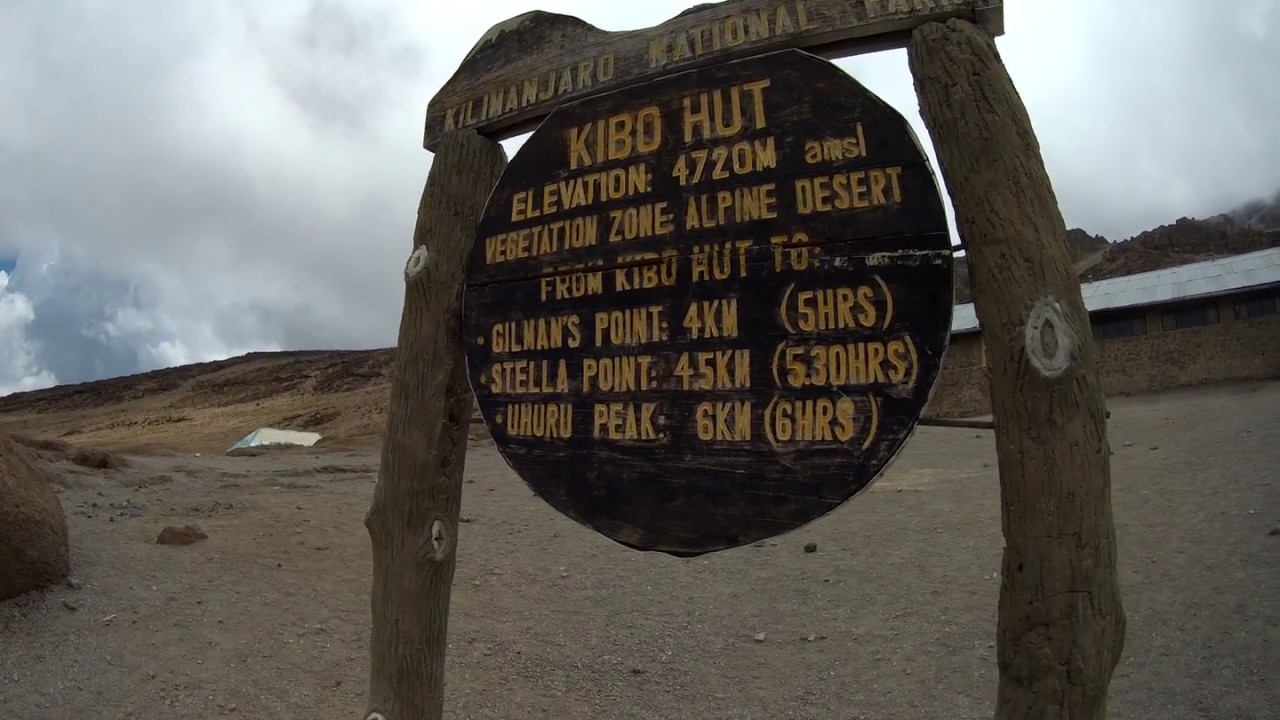
Kibo Huts are set on the eastern side of the Kibo volcanic cone at 4,720 meters (15,487 ft) above sea level. It’s your base camp for the summit attempt, where your final push to Uhuru Peak begins. Here, you will rest (we highly recommend it for summit success).
The camp is in the Alpine Desert, where temperature and pressure drop significantly. It’s time to use heavy layers to stay insulated and, whenever required, oxygen cylinders. At higher altitudes like Kibo Huts, all you can see are rocks and maybe glaciers. A few animals survive in this ecological zone, including leopards, servals, elands, and wild dogs. Add to the list insects, rock hyraxes, and birds.
Kibo Huts Facilities
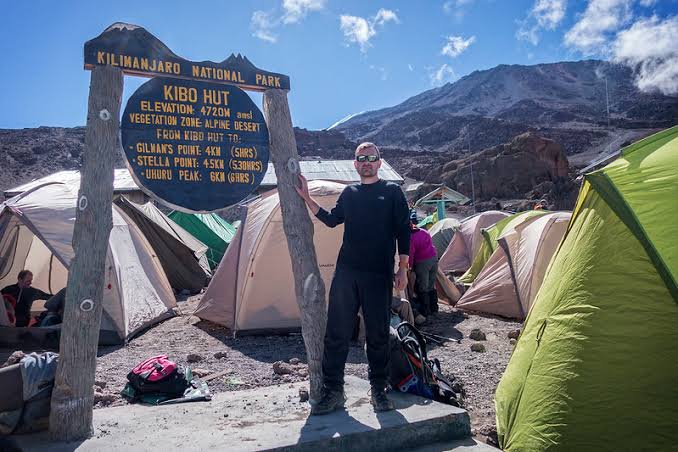
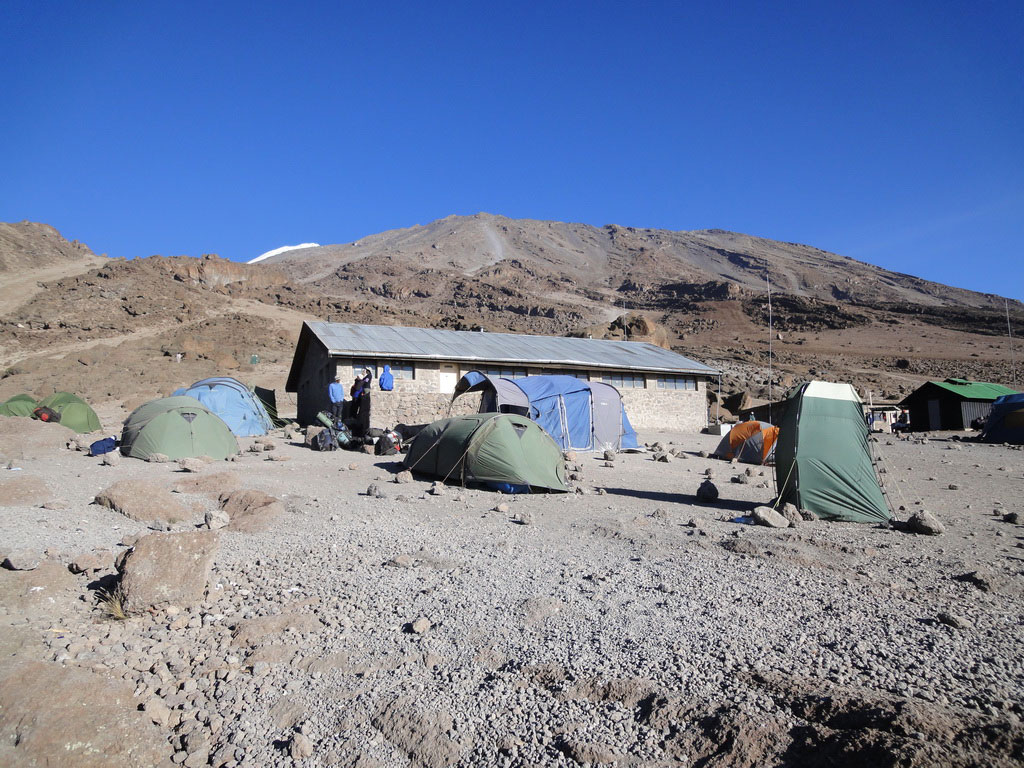
Like other camps on the Marangu route—Mandara and Horombo—Kibo features A-framed huts with the capacity to host 60 climbers per night. In addition to dormitory-style houses, Kibo offers tents when cabins are fully occupied. Each hut has bunk beds that can accommodate 6-8 people for one night. There’s a dining room where climbers eat their meals. The camp also has a separate house for the guides, porters, and chefs, and a hut for the ranger. It has no flush toilets. Long-drop toilets are present at the back of the main hut.
The hike to the Kibo Huts
After spending two days at Horombo Huts (one for hiking and another for acclimatization), we’ll hike to Kibo Huts. The hike takes about 6-8 hours of hiking, and you’ll end up at about 4,720 meters (15,487 ft) above sea level. You’ll hike past a saddle that connects Kibo and Mawenzi Peaks. Upon arriving at Kibo Huts, the crew will prepare everything early on, like dinner and water. Our pro tip is to make sure you go to bed early to prepare for the summit attempt that will start shortly at midnight.
Having sleep problems? Worry not! Your body is undergoing some changes internally and externally, so it can adapt to higher altitudes. Sometimes, it may be difficult to fall asleep. At Explore African Safaris, however, we know how to help our clients sleep well, especially at higher altitudes like that of Kibo Huts. First, we ascend slowly to give your body the room to adapt. Second, we supply enough drinking water and remind you to hydrate regularly. And lastly, we provide nutrient-rich meals to support your body’s adaptations.
The summit attempt at a glance.
Since the final push to the ‘roof of Africa’ starts at Kibo Huts, it makes sense for us to say a little bit about it. Our final ascent will be done during the night. Why? There are several reasons for this (check our article about the summit attempt), one being to target the sunrise and the other being the length of the hike.
After an energizing cup of coffee, we start trekking ‘pole pole’ (slowly slowly). You have 6 kilometers ahead of you. Our guides will lead the way slowly. We’ll have regular breaks to hydrate and catch your breath. You will hike past famous peaks, including Gilman’s Point and Stella Peak, and finally reach Uhuru Peak (5,895 meters / 19,341 ft), which is Africa’s highest point.
Now, you’ve completed the first part. It’s time for the second part—to descend to Horombo Huts. After taking as many pictures as you want at the peak, we start the hike down. We stop at Kibo Huts for lunch, then descend to Horombo for dinner and a well-deserved sleep.
Kibo Huts Altitude Sickness Tips.
After leaving Horombo, you’re going all the way uphill to a higher altitude—above 13,000 ft. Oxygen supply decline triggers your body to adapt or not. If you have enough exposure to high altitudes, then you’re good to go. But if you’re not, altitude sickness may show up.
What’s altitude sickness? This is the kind of disease that can literally affect anyone at high altitude, science says. It can be mild, with symptoms like headaches (which are mistakenly attributed to dehydration) and nausea. This can affect anyone above 10,000 ft, and there’s no problem with it because it’s manageable.
Severe forms of altitude sickness include High Altitude Cerebral Edema (HACE) and High Altitude Pulmonary Edema (HAPE), which are extremely dangerous. And at this point, evacuation is mandatory. Our rescue team will help you descend for medical help.
But there’s a piece of information we want you to know—that serious forms of altitude sickness happen at Kibo Huts. This is mainly because of high altitudes and anxiety. To avoid this, we highly recommend you acclimatize at the Horombo Huts before going to Kibo. Also, try not to overthink the summit attempt. Mental load can contribute to altitude sickness.
Frequently Asked Questions
Why does the summit attempt start at midnight from Kibo Huts?
The summit attempt begins at midnight to enable climbers to reach Uhuru Peak at sunrise for an unforgettable view. The glacier is also intact during the night and makes it easier to ascend.
What facilities are available at Kibo Huts?
Kibo Huts feature A-frame dormitory-style cabins sleeping 6–8 per bunk room (up to 60 climbers total). It also has a shared dining hall for meals and separate huts for guides, porters, and rangers. There are no flush toilets or showers—only basic long-drop toilets.
How cold does it get at Kibo Huts, and what should I pack for the night?
Temperatures in the alpine desert zone around Kibo Huts (4,720 m) can drop significantly, especially at night—often to -5°C to -15°C (23°F to 5°F) or colder with wind chill. Days might feel warmer (around 10–15°C), but the thin air makes it feel harsher. Pack insulating layers like a jacket, gloves, a balaclava, and a warm sleeping bag.
Climb with us
At Explore African Safaris, we go the extra mile to help you reach the top. Is it your first time climbing Kilimanjaro? Don’t worry! Our guide will help you through it. We tailor every climb based on the experience of our client. Let’s plan your climb.