
Get to Know the Maundi Crater
Get to Know the Maundi Crater, Kilimanjaro has seven well-established routes. Among them is the Marangu route, also called the ‘Coca-Cola’ route. It is short (taking just 5 days to complete), has a gentle inclination, and is the only route with well-erected permanent huts. Therefore, it’s appealing for many beginners. However, Marangu has low success rates of around 60-70%, especially for 5-day climbs. So, we strongly suggest you include an extra day of acclimatization.
Acclimatization is done at Horombo Huts, the second camp after Mandara Huts. On this day, you’ll hike from Horombo (12,205 ft) to Mawenzi Ridge (14,400 ft) and then back to Horombo. But before this hike, a hike to Maundi Crater is a great way to familiarize your body with higher altitudes. Our article reveals everything about this beautiful crater.
What is Maundi Crater?
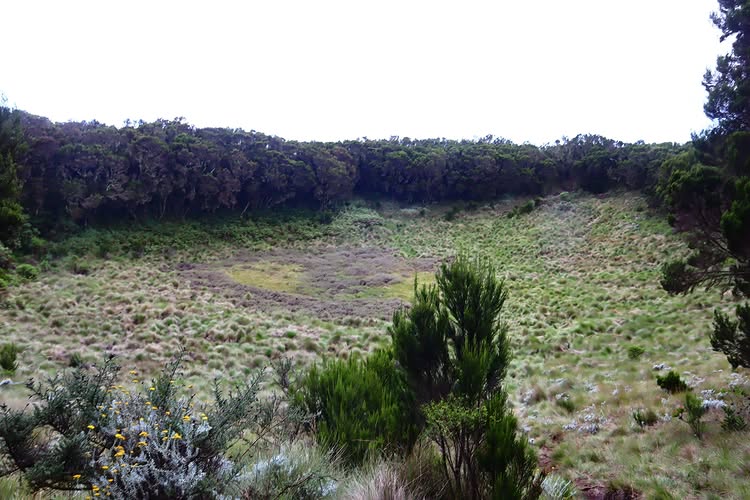
If you choose to climb Mount Kilimanjaro via the Marangu route, Maundi Crater is your stopover point. Maundi is an extinct crater near Mandara Huts, the first camp on the Marangu route. This crater lies in the rainforest zone of the mountains at about 2,780 meters (9,120 ft) above sea level. And why should you trek to this marvelous geographical feature? Because it’s beautiful, and it’s best for acclimatizing before you go higher uphill.
Much is said about the Marangu route, especially its low success rates. But there’s a way to boost your success rate. Climbers fail due to altitude sickness. The best way to avoid this is getting used to higher altitudes. And hiking to Maundi Crater is one of the best ways to increase your summit success. The hike to Maundi is just a ‘walk-up’ trek, but with some strenuous sections demanding energy. This prepares your body for the toughest parts.
Maundi Crater geology
Geologically, Maundi Crater is a small volcanic depression formed by secondary eruptions from Mount Kilimanjaro’s main massif during its active period. The crater floor has volcanic soil—hence minimal vegetation with grasses covering the floor and dense rainforest along the edges.
Top Activities to Do at Maundi Crater?
Is the hike to Maundi Crater worth it? What can I do or see? We’ve got you covered. You have a lot of things to do here, including
- Acclimatization. As we said earlier, getting your body used to high altitude is essential for a successful climb. Maundi is about 2,760 meters above sea level. That elevation is enough to trigger body changes that make you adapted to high elevations.
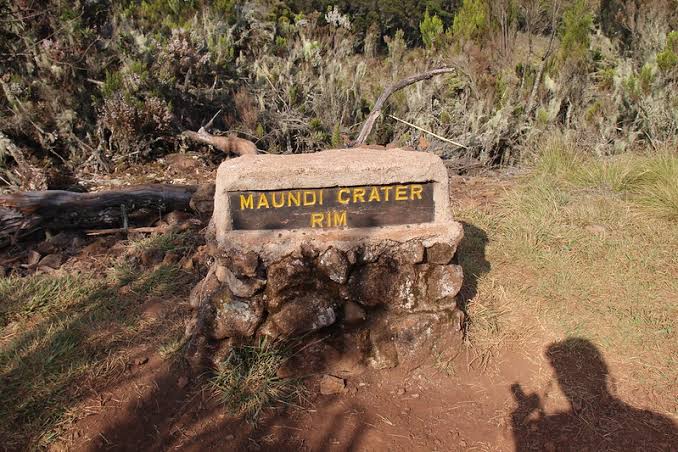
- Exploring the scenery. Maundi has an attractive view. From the crater rim, you can view the Mawenzi peaks, the slopes of Mount Kilimanjaro, and even into Kenya. The grassy floor contrasts with the dense rainforest rim. You can sit under a tree’s shade and explore the crater floor or descend into it to learn more about the soil. Our guides are knowledgeable not only about Maundi Crater but also every trail on Africa’s highest mountain.
- Taking photos. Of course, yes. Photos of the crater turn out stunning. The grass-covered floor is so marvelous, while the forested rim is eye-catching with monkeys jumping from one branch to another. On top of that, there are striking flowers like red hot pokers and so on.
- Exploring wildlife. Maundi lies in the rainforest zone of Mount Kilimanjaro. So, expect to encounter many animals, including black-and-white colobus monkeys, blue monkeys, three-horned chameleons, hyraxes, and birds like malachite kingfishers, turacos, cuckoos, and bee-eaters.
The hike to Maundi Crater
You can visit Maundi during your Kilimanjaro hike. It’s also possible to go there for a Kilimanjaro day hike. Either way, you’ll drive from your hotel in Moshi or Arusha (but we recommend you stay in Moshi because it’s just 45 minutes away from the mountain: it saves time).
After arriving at the Marangu Gate, we’ll handle park entry formalities. (Don’t worry—our guide will handle the matter). The lower part of Kilimanjaro features animals such as Colobus monkeys, elephants, mongooses, etc. So, keep an eye out for them. Sometimes, it can be tempting to navigate this zone because of the mud and the slipperiness, and you can’t skip it. Bring good hiking boots and trekking poles.
You will spend 3-4 hours (depending on fitness level) navigating through the montane forest until you reach Mandara Huts, where you’ll eat lunch. After lunch, we then set off for Maundi Crater, which is just 15 minutes from the huts. Spend quality time watching animals and exploring the forest, and prepare yourself for the toughest part of the climb. You may also meet other climbers there and connect.
When to visit Maundi Crater?
The dry season is always the best time for either a Kilimanjaro hike or a Maundi Crater day hike. In Tanzania, this period runs from June to October and from January through early March. During this time, the sky is clear for watching the peaks of Kilimanjaro, the trail is dry for easy navigation, and there’s little to no rainfall.
Frequently Asked Questions
How difficult and long is the hike to Maundi Crater?
The hike is easy and suitable for beginners. It’s a 15-20-minute walk uphill towards the crater rim. For a full-day hike from Marangu Gate, expect 3-5 hours to reach Mandara Huts. Bring good hiking boots.
What views can I expect from Maundi Crater?
On a clear day, the views from the crater rim are stunning. You can view Mawenzi Peaks, Kilimanjaro’s lower slopes, and even Kenya. It’s the best spot for photos.
What wildlife might I see around Maundi Crater?
Maundi Crater lies in the rainforest zone of Kilimanjaro. Here you can see black-and-white colobus monkeys, blue monkeys, three-horned chameleons, and colorful birds, such as turacos, cuckoos, malachite kingfishers, and bee-eaters.
Hike Kilimanjaro with Explore African Safaris
The Maundi Crater hike is as important as your acclimatization day. That’s why at Explore African Safaris; we take it seriously. Our guides will accompany you to and from this magnificent crater. So, what do you think? Book a Kilimanjaro climb with your responsible, legally registered operator—Explore African Safaris. We’re excited to host you.