
7 Days Arusha Manyara Serengeti and Ngorongoro
Day 01: Departure from Home Arrival Arusha Overnight at Arusha
Depart from home and take your preferable airline to Tanzania, Kilimanjaro International Airport (JRO).
Meet upon arrival at Kilimanjaro International Airport with our professional driver guide who will warmly welcome you to our beautiful country.
Our professional Driver Guide will transfer you to Arusha (a one-hour drive). Check-in at the Hotel/Lodge for dinner and overnight.
Arusha city (The Geneva of Africa) is the capital of the Arusha region situated in northern Tanzania. It boasts a population of 617,631, and the Arusha Region, with a population of 2,356,255 (2022 census) with a majority of the African population, large Arab and Indian minorities, and many European and American experts, engaged in diplomatic affairs and the fast-growing local tourist industry. Arusha is a major international diplomatic hub, as, since 1994, it has been hosting the International Criminal Tribunal for Rwanda and the Capital of the East African Community since its inauguration. It also hosts the African Court on Human and Peoples Rights, the East African Court of Justice, the African Union Advisory Board on Corruption, and many other international agencies.
Despite its proximity to the equator, Arusha’s elevation of 1,400 meters (4,600ft) on the southern slopes of Mount Meru (fifth highest in Africa) keeps temperatures relatively low and alleviates humidity. Cool and dry air is prevalent for much of the year. The temperature ranges between 13 and 30 degrees Celsius with an average of around 25 degrees. Arusha has distinct wet and dry seasons and experiences an eastern prevailing wind from the Indian Ocean, a couple of hundred miles from the East.
Optional Activities
Arusha City Tour
Tanzanite Experience
Accommodation: Arusha Serena Lodge/ Tulia Boutique
Meal Plan: Full Board
Day 02: Arusha to Manyara National Park
Breakfast at leisure and safari briefing at your hotel.
Thereafter, drive to Lake Manyara (two hours’ drive) arriving by mid-day with Packed Lunches for an afternoon game drive in Lake Manyara National Park whose inhabitants include hippos, monkeys, tree climbing lions, flamingos, and other varieties of birdlife.
Lake Manyara National Park is one of the most diverse of Tanzania’s national parks, a tiny (325km², about 205sq miles) combining the Rift Valley, Lake, dense woodlands, and steep mountainside. This park is very famous for its tree-climbing pythons and tree-climbing lions, which spend most of the day, spread out along the branches of Acacia trees six to seven meters above the ground. Manyara is a birding paradise (more than 380 species), especially for waterfowl and migrants and the forests are one of the best places around to see leopards. Lions hunt on the grassy shores of the lake. The park is also particularly noted for its huge herds of buffalo and elephants, as well as giraffes, impalas, hippos, and a great variety of smaller animals.
Late afternoon proceeds driving to the lodge for dinner and overnight.
Check-in at Lake Manyara Serena Safari Lodge/Twiga Lodge for dinner and overnight
Dinner and overnight at Manyara Serena Safari Lodge/Twiga Lodge for dinner and overnight
Day 3: Drive from Manyara to Serengeti
Enjoy your spontaneous buffet breakfast at the lodge.
Depart driving to Serengeti National Park via Ngorongoro Conservation Area for a game drive.
With a game drive en-route drive in the endless plains of Serengeti proceed to the camp/lodge for a hot lunch.
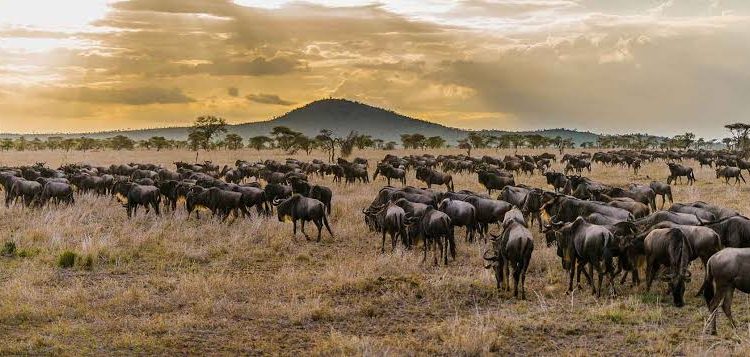
Serengeti National Park is one of the best-known wildlife sanctuaries in the world. It covers an area of about 14763sq km, with various vegetation, grassy plains, savannah acacia lands, wooden hills, and mountains which are the backdrops for an extraordinary concentration of animals that reaches its peak during the wildebeest migration. It is said to be around 2 million wildebeests in Serengeti that migrate every year from Maasai Mara plains. The best time to see the wildebeest migration is from December to July, and the best time to see predators is from June to October. Serengeti is among the world’s remaining natural wildlife refuges. The name comes from the Maasai ‘Siringet’, meaning endless plains, and is equal in size to Northern Ireland. The Park contains an estimated three million large animals, most of which take part in seasonal migration which makes it one of nature’s wonders.
Optional Activities:
Olduvai Gorge Museum Visit
Visit to the local Maasai village and a lecture on the Maasai presented by a Maasai naturalist
Nature walk
Empakai Crater visit.
Late afternoon returns to lodge/camp for dinner and overnight
Accommodation at Serengeti Serena Safari Camp/Central Serengeti Bush Camp
Day 4 & 5: Full-day game viewing in Serengeti National Park
Wakeup call and get up early for coffee/tea at the lodge and depart for the balloon ride. Probably the most beautiful balloon flight in the world and the ultimate Safari Experience! The Balloon ride is offered as an optional activity.
You will be picked up at 5:00 am and transferred to the balloon launch site. Here you will meet your pilot, receive a briefing and watch the inflation of your balloon. At dawn it takes off, rising as the sun rises and floats whichever direction the winds of the morning take it. Your pilot can precisely control the altitude of your balloon: sometimes flying at treetop height, sometimes lower, offering a unique perspective and great photographic opportunities of the wildlife below. At other times our pilot may ascend to 1000 ft or more to see the enormity and wonderful panorama of the Serengeti. From time to time the pilot must put more heat into the balloon with the powerful whisper burners. In between these burns, there is silence apart from the natural sounds below.
The flight is for about one hour depending on conditions, and eventually, you must land. You celebrate in the traditional manner with champagne (well, an excellent sparkling wine) before sitting down to a full English breakfast prepared and served in the bush in “Out of Africa” style with bone china, linen table cloth, King’s silver, etc. After breakfast, you receive your Serengeti Balloon certificate and later meet up with your safari drivers ready to continue your day’s activities.
Early morning game drives are usually given a chance of seeing predators hunting.
Lunch at mid-day. Lunch can either be a hot lunch at the lodge or a picnic lunch at a picnic site in the plains of Serengeti.
Late afternoon check-in at Camp/Lodge for dinner and overnight
Accommodation at Serengeti Serena Safari Camp/Central Serengeti Bush Camp in a Full Board Basis
Day 6: Serengeti -Ngorongoro Conservation Area Crater
Breakfast at the Lodge.
Depart to Ngorongoro Conservation Area for a Crater tour.
you will descend 2000 feet (over 600 meters) to the floor of the crater for a day tour with picnic lunches. The stunning spectacle of the Ngorongoro is undoubtedly one of the highlights of a safari tour in Tanzania. “There is nothing with which to compare. It is one of the wonders of the world”, once wrote Professor Bernard Grzimek. On this day, you will explore the forest areas that are inhabited by monkeys and elephants, the lake area, where you may see the flamingos and the open savannah where the lions hunt for food.
Enjoy your lunch on one of the finest picnic sites in the crater with free Wi-Fi facilities and reasonable washroom facilities.
Picnic lunches are taken instead of hot lunches to give clients more time in the crater, and avoid double payments, as crater tours are conducted on a single-entry basis.
In the evening ascend the crater floor and proceed to the lodge for a dinner and overnight.
The Ngorongoro Crater is 2,286m above sea level and is the largest unbroken caldera in the world. Ngorongoro is surrounded by very steep walls rising 600 meters from the crater floor. The crater was been declared a World Heritage Site. The views at the rim are sensational. On the crater floor, grassland blends into swamps, lakes, rivers, woodland, and mountains – all a heaven for wildlife, including the densest predator population in Africa. The crater is home to up to 25,000 large mammals, mainly grazers – gazelle, buffalo, eland, hartebeest, and warthog. You will not find giraffes as there is not much to eat at tree level, or topi, because the competition with wildebeest is too fierce, nor will you find impala. The crater elephants are strangely, mainly bulls. There are a small number of black rhinos here too. The birdlife is largely seasonal and is also affected by the ratio of soda to fresh water in Lake Magadi on the crater floor.
In the evening ascend the crater and proceed to Ngorongoro Serena Safari Lodge/Hando Lodge.
Dinner and overnight at Ngorongoro Serena Safari Lodge/Hando Lodge.
Day 7: Ngorongoro-Tarangire National Park
Relaxed Breakfast in the morning at the Lodge.
With picnic lunches, depart driving to Tarangire National Park for a game drive.
The vast number of baobab trees and a large herd of Elephants will catch your attention as you enter the Tarangire gates.
Tarangire is far from being the biggest of the Tanzanian parks, but its unrivaled landscape of open plains, dotted with thousands of baobabs, is unforgettable. About 120 km south of Arusha, Tarangire is known for its very big herds of buffalo. This is one of Africa’s little-known gems and should be on the itinerary of all lovers of wilderness and solitude. The game numbers are staggering: 30,000 zebra, 25,000 wildebeest, 5,000 buffalo, 3,000 elephants, 2,500 Maasai giraffes, and over 1,000 fringe-are oryx (gemsbok). Predators include lion, cheetah, and leopard and birders will want to look out for the endemic ashy starling, rufous-tailed weaver, and black-collared lovebird.
Optional Activities
Balloon Safari (with adventure aloft)
Visit Masai Community Visit
Night Game drives (if staying at Roika)
Check-in at Tarangire Sopa Lodge/Roika Tarangire
Dinner and overnight at Tarangire Sopa Lodge/Roika Tarangire
Day 8: Tarangire -Arusha-Kilimanjaro International Airport
Pleasant breakfast at the lodge.
Drive to Arusha coffee lodge in Arusha Region for a hot lunch.
Late afternoon transfer to Kilimanjaro International Airport for your onward flight back home.
End of our services.
