
What To See In Serengeti National Park : When prompted to name an iconic wildlife destination in Africa to visit on your next trip, what would it be? Whatever the answer you have Serengeti can be better. This is iconic and is well known for its amazing wildlife diversity and picturesque landscapes ranging from the endless plains to woodlands and kopjes.
Serengeti National Park is a world-class tourist destination. It lies in the northern part of Tanzania also the Northern Circuit. You probably know less about this park. Even if you have been there or know more about this spectacular park, this article will still add your knowledge about Serengeti.
#1. The Big Five
Back in the day, hunters used to kill animals for a trophy. They experienced difficulty in hunting lions, leopards, elephants, buffalos, and rhinos. These animals are dangerous and pose a great threat to their predators and that is the reason they are called the Big Five. If you want to see all these big games in one destination, Serengeti is your ideal destination.
Lions are everywhere in the Serengeti. They dominate the grassy plains in groups. They are the most terrifying animals of the Big Five. They usually prey on many herbivores but mainly antelopes, wildebeests, zebras, and even larger games like buffalos.
Lions are social and territorial animals. They live in groups of up to 20 individuals, mainly consisting of adult males and females and cubs.
Elephants are common in the Seronera Area. These terrestrial giants feed on grasses and tall trees. As they tear down tall trees, they help to trim the bush such that other animals can get around it. It is not a surprise to spot large herds in northern Serengeti.
The Cape buffalos form big herds of up to 300. You can encounter them in plains and grass-rich woodlands. A few bulls rule the group. They are responsible for mating. Fights between bulls happen and are usually caused by mating rituals.
The leopards are also common in the Serengeti, especially in the riverbanks of the Seronera River. They most of the daytime hiding in trees and become active in early mornings and during the night.
The black rhino is rare. Serengeti hosts about 160 black rhinos. The sightings are not guaranteed but with an experienced guide, it is possible to see them. Rhinos are solitary. They live in shrubs to avoid noises from other animals. As you drive in the shrubs, watch out for black rhinos.
#2. The Great Migration
The wildebeest migration is a spectacular event featuring nearly 2 million wildebeest and thousands of zebras and gazelles. These grazers form big herds and move from the southern part of Serengeti to the north.
This event is natural and does not have a specific timetable, though it is possible to predict the events. The most captivating events include the calving season, massive trekking, and crossings of the Grumeti and Mara Rivers. You may be wondering what usually causes the wildebeest to migrate. The main cause is the search for green grazing grounds.
Between December and February, about 500,000 calves are born. Almost 5,000 calves are born every day in the southern Serengeti and Ndutu area. Witness a newly born wildebeest taking its first step just 3 minutes after birth. Predators like lions, leopards, hyenas, cheetahs, etc. take advantage of weak animals. You may witness the predator-prey dynamics.
By the end of May, rainfall starts to decline causing a shortage of pasture and water. Since the group is huge, it starts the journey eastwards near the Ngorongoro Conservation Area. It then passes through the central Serengeti.
Between June and July, the wildebeest is in the western corridor. They cross the Grumeti River, and that is their first dangerous challenge. Hungry crocodiles find their way on weak wildebeest to get a meal. After this river, the herd faces the Mara River in the north. This event is dramatic and wipes down a significant number of wildebeest, especially the weak and young. Perfect scenes and photos have been shot here.
When to see the Great Migration
The wildebeest have their clocks. So, if you want to see this great event, plan your trip well. You also have to decide on the event you are interested to see. Whether it is calving season, Mara River crossings, or any other. For any updates about the wildebeest migration, please reach out to our team.
#3. Wildlife
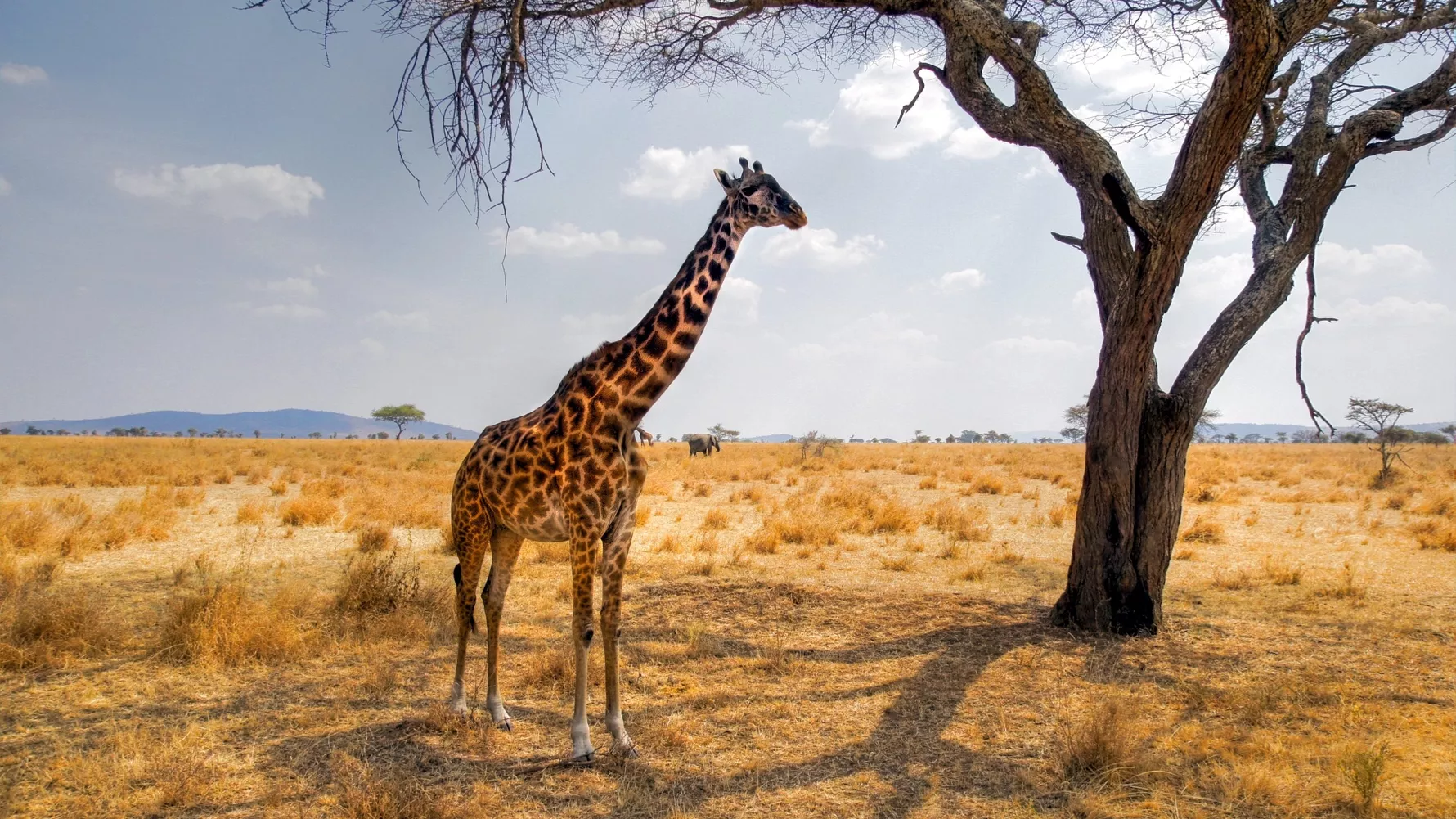
Serengeti is known for its diverse wildlife across its wilderness. From grazers to apex predators, Serengeti is the home of a myriad of wild species. You may see giraffes, antelopes, jackals, impalas, cheetahs, hyenas, etc.
There is a lot to discover including unique flora species. The vegetation cover is picturesque. Beautiful flowers blossom between March and April. Reptiles and small animals are abundant in the Serengeti. They thrive in a world of big games, though you need more attention to notice. Short walks are perfect ways to view them.
#4. Birds
Serengeti is also the home of birds. Over 500 bird species live in this park. Some of them include ashy starling, yellow-billed stork, yellow-collared lovebird, Fisher’s lovebird, bright-hued small parrot, lilac-breasted roller, Kori bustard, Marabou stork, Grey-crowned crane, and many others.
In Serengeti, you may also see specialties, including Schalow’s turaco, African fish eagle, red-throated tit, secretary bird, Fisher’s lovebird, grey-crested helmet shrike, and Rufous-tailed weaver.
Serengeti is a world-class destination. You will find many other attractions and that would also be interesting, but Serengeti will always rank first on the list of most attractive safari destinations in East Africa. If you are interested in visiting the Serengeti, book a trip with Explore African Safaris, and rest assured that you will receive nothing other than the best service.
